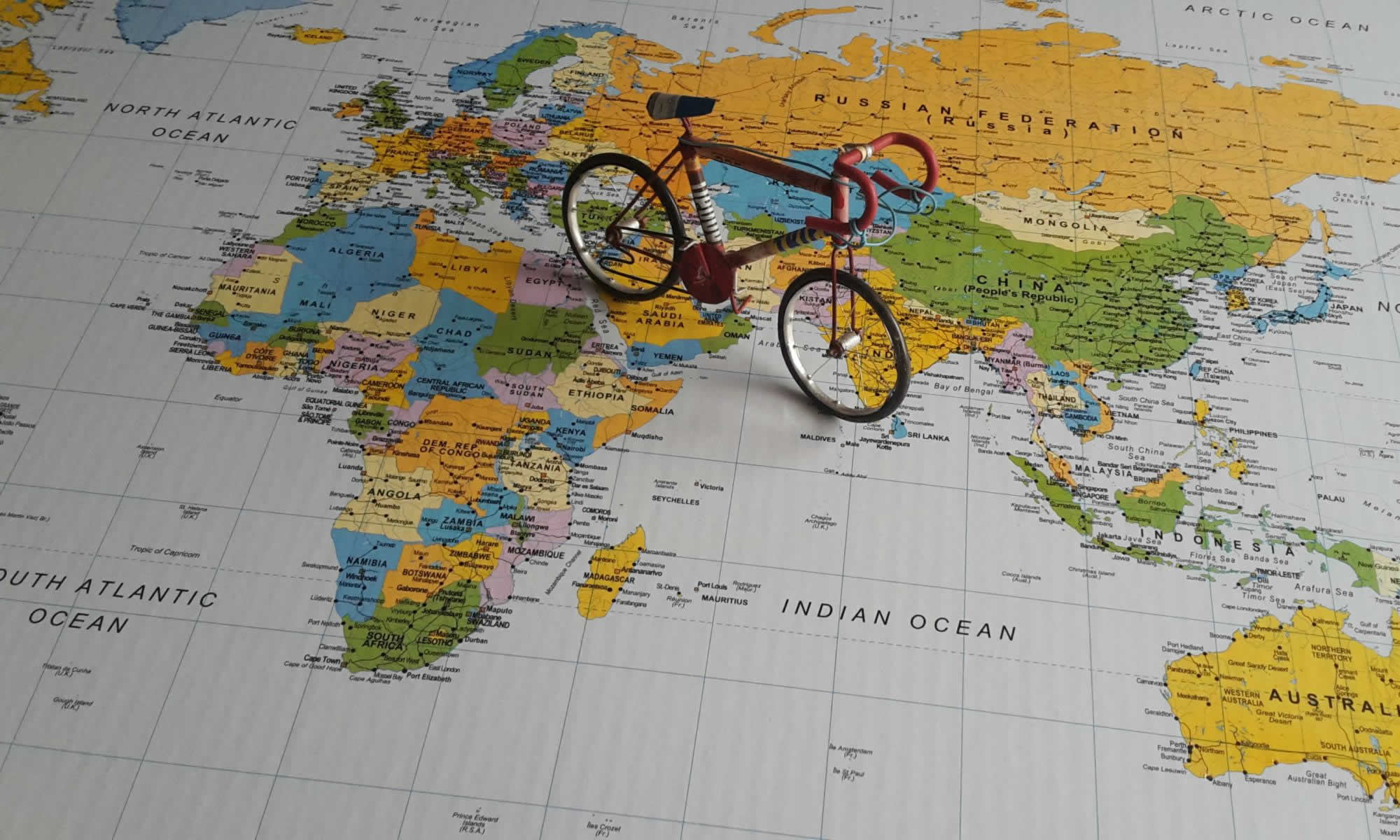


Planning a bicycle tour, one of the questions I get asked a lot. So I thought I’d explain and put down in writing what I do. It might not be the best way, but it works for me!
The truth is, I don’t! All I do is look at a map of the country I want to tour. See if there’s a road going where I want to go. Roughly work out the mileage, which in the old days used to entail a piece of string, laid on a map! But these days things are a lot easier, and I tend to use Google maps.
Once I’ve worked out the mileage I just divide that by 80, which is the distance, I like to cover each day and go! Although that’s not strictly true if it’s a big tour involving several countries, I do put in a bit more time and effort in then! But if it’s just the one country or I’m travelling in Europe it is just a case of looking at a map, see how long I’ll be away for and go!
Planning A Longer Trip
Planning a bicycle tour that involves several countries, apart from checking the mileage, I always check on the visa requirements. Whether it’s visa on entry (where you obtain the visa at the border) or if it isn’t then what city do I need to pick one up from or do I get it before leaving home.

Getting a visa before leaving home is sometimes the easiest option. But it can be more expensive, involve a lot of time and require a lot of documents!
Although obtaining a visa before leaving isn’t a bad idea. It’s sometimes easier to get a visa on the road. Consulates in neighbouring countries tend to be a lot more accommodating and are pleased that you want to travel their country.
For example, when I travelled to Kazakhastan, on my world tour, I got their visa while in England. But they would only give me a visa for 30 days, which had to be used within a 90-day slot! After reaching Azerbaijan, my last country before Kazakhstan. I realised I wouldn’t be able to cycle across Kazakhstan within my 90-day slot! As a result, I went to the Kazakhstan consulate in Baku, to apply for another visa. After an interview, with the ambassador, he asked how long I wanted? One month, two months or three!!
Border Crossings
Another point I always check when planning a bicycle tour is the entry and exit towns for a county, as not all borders are open to tourists. I couldn’t think of anything more annoying than to have spent a week or two riding across a country only to find that you couldn’t cross the border!

I also like to check either on route or before leaving home what the local currency is and make a note of the exchange rate. So when exchanging one countries currency to another with the inevitable touts you find at the border, I know how much I’m being ripped off by!
Gear To Take
Usually, my panniers are prepacked, and the only ones I need to pack are the ones containing toiletries, clothes and my sleeping bag (see gear and equipment post as to what I take)
Maps
I also always try and set off from home with all the maps I need or at least one per country, which covers the entire country just in case I can’t find any on-route. And because I tend to cover long distances is usually sufficient enough. The maps I use depends on the length of the tour. For an extended trip covering several countries, I use Michelin national maps. For shorter trips, I use Michelin regional maps.

Another set of maps I’ve used are the German Reise range I find them clear and easy to follow. None of the maps I use has contours on them, to me the world is flat! Which suits me, I prefer not to know if a hill or mountain is coming up! I’ve found from experience that if I know, a climbs coming up at some point in the day, I spend all day thinking about how steep or long it might be!
Sometimes you can tell on the maps when it’s going to be hilly particularly the Michelin maps! The roads shaded with green signifying a scenic route which typically equates to it being hilly! The higher passes also get marked, but then I try and ignore them and pretend I didn’t see them!
Arriving In A New Country
When arriving in a new country be it by air, sea or land, it’s a good idea to have an address of a hotel. Most countries require you to fill out the address of where you’ll be staying on the landing or entry card. But from my experience, you don’t have to stop there! It seems to be more of a formality and the only time that I do stay at the address I’ve given is when I fly into a country! (See below)
Accommodation
Accommodation or any stops never get planned or pre-booked I never know where I’ll end up from one night to the next! Why waste time trying to find accommodation in advance? You may not reach that place, you may decide to stop early, or you may find another route that you want to explore. When I do arrive in a town, I tend to stay at the first place I see.
Usually, I prefer to camp, it keeps costs down and means I can stay away for longer! But if there’s no campsite around, I don’t wild camp anymore not unless I really have to! I’ll stop at the first available hotel, inn, guest house, hostel or whatever is available!
I’ve learnt through experience that you can cycle around a town for ages looking for accommodation and then be undecided as to which one to stay in! Generally, they are all the same and if it’s only the one night that your staying, does it matter what it’s like as long as they have room and bed. (A bar is also preferable!)
The exception to the rule is when I fly into a country, then I do pre-book a hotel. It saves a lot of aggravation trying to find somewhere after a long flight. It also means I can reassemble my bike in the hotel room or somewhere in the hotel. Assembling the bike at an airport is okay in Europe, but in Asia, you get a lot of attention and a large crowd!
At The End Of A Tour
When coming towards the end of a trip and I’ve got a flight to catch I usually check out a cities hotels before getting there. I still don’t pre-book anything I just like to have a rough idea of a western-style hotel that I can head for. It’s useful if the staff speak good English when trying to source materials for packing things away ready to fly. Read Garry’s post taking a bicycle on an aeroplane.
Packing
When packing away for a flight, I always get one big bag to put my panniers in. Usually, one of the chequered type that seems to be available in most countries. Their cheap, light, and don’t add any extra weight. Chances are you’re probably close to the weight limit as it is! The bags are not particularly strong, but you only want it to last that flight! If you’re worried about it surviving the trip, you can usually get it wrapped in cellophane at the airport.
For the bike, you can obtain a cardboard box from a local bicycle shop. They’re often quite grateful to give it to you for free, it saves them having to dispose of it! Although that’s not always the case. When I was trying to find one in Istanbul, they wouldn’t give me one unless I paid for it and as for China! Nobody would give me one for love nor money! And I had to make my own!

Lose Excess Weight
Once I’ve sourced all the packing materials, I dismantle the bike and box that up. I then get rid of any excess weight! I’m always amazed at the end of a tour how much extra weight I’ve accumulated! Catching a flight for me is a good thing, it’s the only time I clear my bags out completely! As I do a lot of touring, in Europe that doesn’t involve a flight. I tend to leave my backs packed all the time. On a recent trip, when I cleared out my bags, I found that I’d accumulated six puncture repair kits and three loo rolls!
After losing the excess weight, I then proceed to pack my panniers into the bag. Usually, I manage to pack my tent, two front panniers and one of my rear panniers into the bag. Although sometimes I put the odd item into the bike box if I’m struggling to fit everything in the chequered bag. Or I’m worried about weight. I already have a rough idea of how much my gear weighs, as it’s weighed before leaving home. My last pannier is carried on as hand luggage with some of the heavier items in it. At the airport, the chequered bag gets checked in as hold luggage. The bike as sports equipment or oversize baggage and my last pannier is carried on as hand luggage.

Hi Spike. Where are you off to and when? xx
Hi Liz, nowhere at the moment it was just something that I’d been meaning to write about for a long time